

Journalists Didn't Make the List
/The below story was sent out as part of the FTVLive Newsletter. If you haven’t yet signed up for a completely 100% free newsletter, you can do so here. The newsletter is sponsored by OTA Talent.
An Unsettling Look in the Mirror: Why Don't Kids Want to Be Us Anymore?
Colleagues,
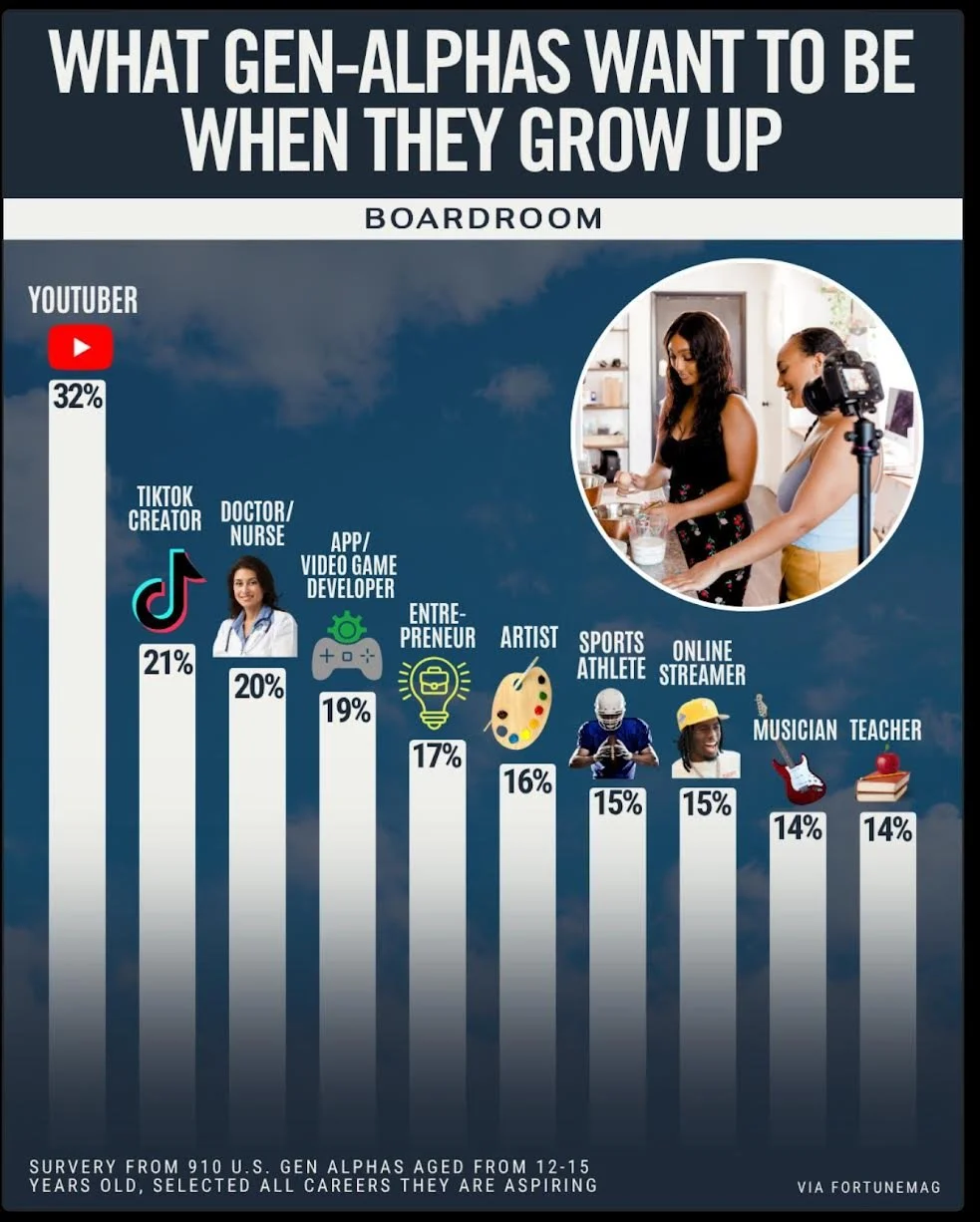
Take a moment and look closely at the graphic above. A recent survey asked Gen Alphas, kids between the ages of 12 and 15, a simple question: "What do you want to be when you grow up?"
The results are a stark reflection of our times. The number one desired career, with 32% of the vote, is "YouTuber." Number two is "TikTok Creator" at 21%. Following them are professions like Doctor/Nurse (20%), App Developer (19%), and Entrepreneur (17%).
As you scan the list of aspiring careers—Artist, Athlete, Teacher—you'll notice something is glaringly absent.
Us.
The job of "Journalist," "Reporter," or "News Anchor" is nowhere to be found. Not in the top five, not in the top ten. It didn't even make the list.
Let that sink in.
Many of us in this field were inspired by the titans who came before us—the Woodwards, Bernsteins, and Walters who made journalism seem like the most vital and noble calling in the world. It was a profession that held power to account, gave a voice to the voiceless, and commanded a unique form of public respect. For generations of young people, being a journalist was a dream. It would have been near the top of a list like this.
Today, the desire for influence, for storytelling, and for building an audience hasn't vanished. It has simply migrated. The data shows that for Gen Alpha, the path to influence isn't through a newsroom; it's through a smartphone. It's not about uncovering a story, but about becoming the story. The "broadcast" is now a livestream from a bedroom, and the anchor is an individual building their own personal brand, one subscriber at a time.
This isn't an indictment of a younger generation. It is a sobering reflection of our own industry. It signals that, in their eyes, our profession has lost its way. Perhaps they perceive a career landscape marked by public distrust, economic instability, and a constant, draining battle against accusations of "fake news." They see the platforms that have disrupted our business model as the new pinnacle of aspiration.
This graphic is more than just data. It's a profound challenge to every single one of us. It asks a difficult question: How do we restore the prestige and perceived value of our profession? How do we reconnect with the next generation and prove that vetted, ethical, and impactful journalism is more critical than ever, especially in a world dominated by content creators?
If we want a future for our profession, we first have to make it a future they can imagine themselves in. Right now, it appears they can't.