

81% Decline
/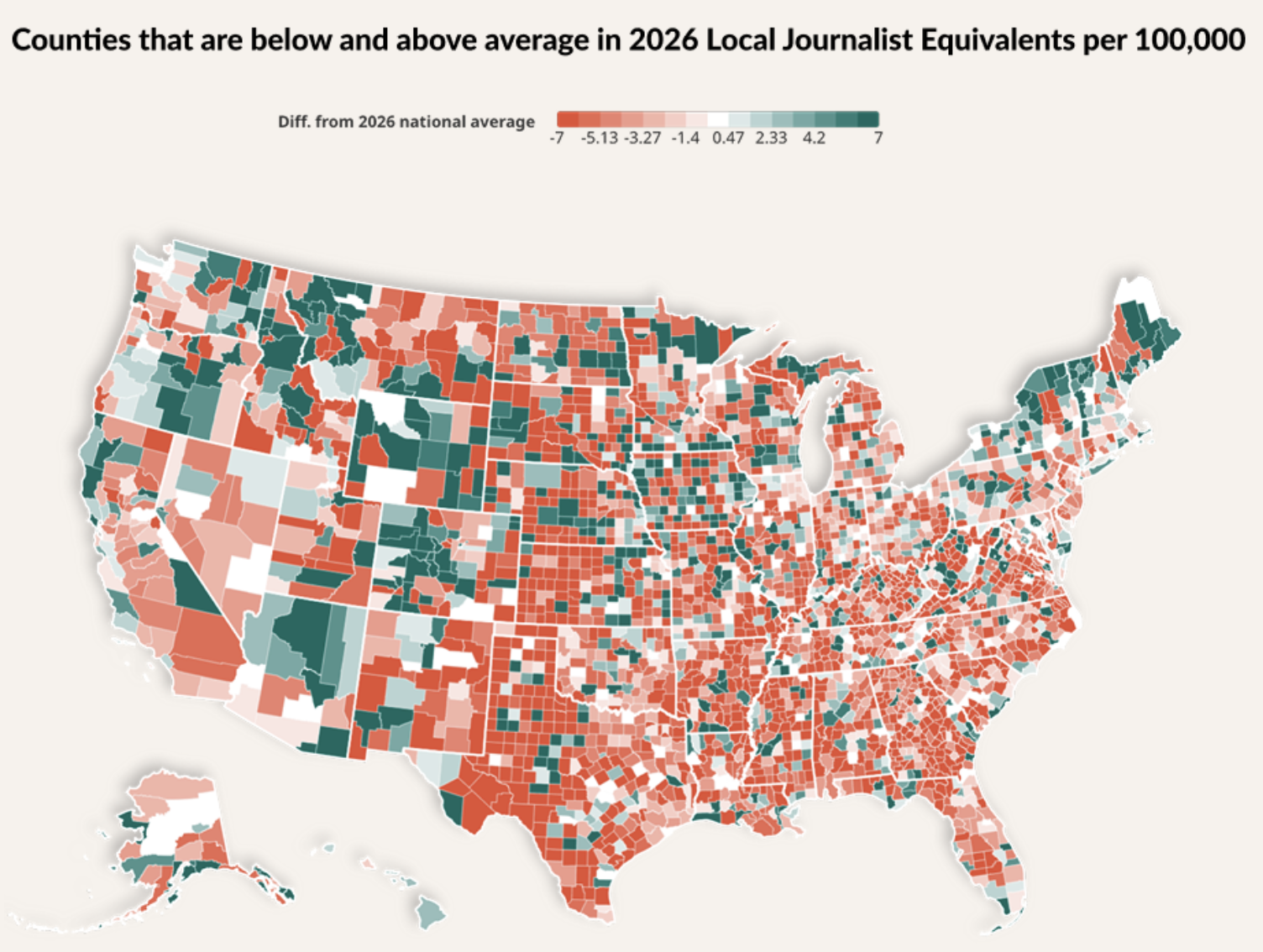
A grim new study highlights the staggering toll of America's vanishing local newsrooms, revealing that the reporter shortage has reached critical levels and is actively harming local communities. The 2026 Local Journalist Index, released by Rebuild Local News and the AI communications platform Muck Rack, shows that the national average has dwindled to just 7.8 local journalist equivalents per 100,000 residents. To put that in perspective, that represents a massive 81% decline from 2002, when there were roughly 40 reporters per 100,000 people. It is a worsening trend, dropping even further from the 8.2 average recorded just last year.
The study analyzed 4.2 million articles published between January and March of 2026 to track coverage gaps across the country. It found that about 70% of U.S. counties, home to an estimated 209 million people, now sit well below that already bleak national average. The collapse of the local beat has left massive blind spots in everyday community coverage. Shockingly, the index found absolutely no local education stories mentioning a community by name in 77% of U.S. counties during the first quarter of the year. The statistics are just as dire for other critical beats, with 76% of counties seeing zero local health coverage, 77% missing environment reporting, and 82% lacking basic transportation coverage.
When local reporters vanish, the entire nature of the remaining news shifts. The report discovered that in news-starved areas with fewer than five journalists per 100,000 residents, nearly one in five local articles is focused on crime and justice. That is roughly 50% higher than the rate of crime coverage seen in counties with a healthier density of journalists. Steven Waldman, the founder and president of Rebuild Local News, called the findings difficult to stomach, noting that the severe reporter shortage is leaving entire communities in the dark on core civic issues.
The data also ties the news crisis directly to financial and social consequences. Areas with fewer local journalists face estimated municipal borrowing costs that are roughly 17% higher than average, accounting for part of a staggering $1.1 billion in annual financial harm nationwide because there is less oversight on local government spending. Socially, counties in the bottom fifth for journalist density scored significantly lower on civic participation, tracking fewer voters, volunteers, and charitable givers. In what the researchers call double-desert counties—places with virtually no reporters and zero local outlets—civic health scores cratered completely.
Even human connection seems to take a hit, as the index highlights academic research linking weaker local news environments to higher statewide rates of loneliness. Muck Rack co-founder and CEO Gregory Galant expressed hope that the data will drive urgent policy conversations and smarter investments, emphasizing that local journalists are the absolute backbone of community accountability. The report notes that a few bright spots do exist where active investments are being made, pointing to Vermont and Maryland as states bucking the trend with stronger newsroom presence, but the overall national picture remains a stark wake-up call for the media industry.