

Nexstar/Sinclair Might Need to Suck Up Harder to Trump
/
The ambitious expansion plans of America’s largest broadcast television owners, Nexstar Media Group and Sinclair Broadcast Group, have been thrown into immediate jeopardy following an unexpected public intervention by President Donald Trump, who declared his opposition to lifting the Federal Communications Commission’s (FCC) national ownership cap.
The presidential rebuke landed on Sunday, stunning Wall Street and sending the shares of both Nexstar and Sinclair plummeting on Monday morning. Broadcasters have spent years cultivating political relationships and heavily lobbying the administration for deregulation, arguing that removing the 39% audience reach limit is essential for them to compete with Big Tech platforms. However, the President’s concern is less about corporate competition and more about ideological control.
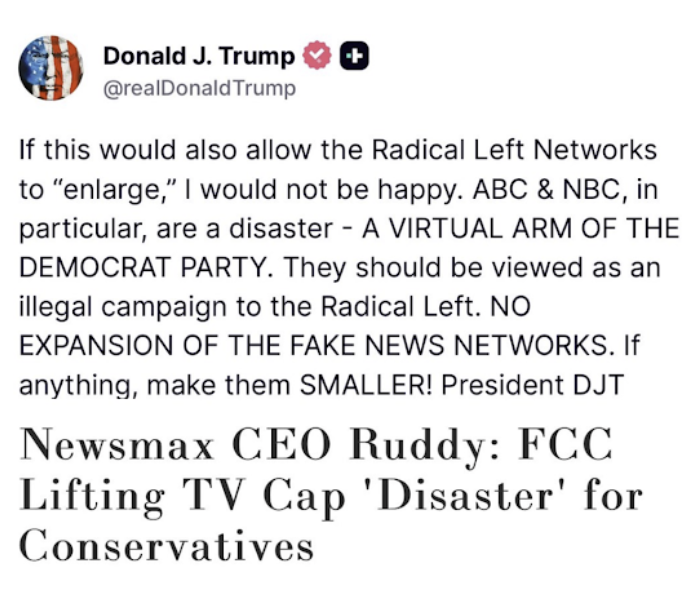
In a post on Truth Social, President Trump stated he “would not be happy” if the cap—which restricts any single entity from reaching more than 39% of U.S. TV households—were lifted. He specifically warned that such a move would allow "Radical Left Networks to ‘enlarge’,” calling networks like ABC and NBC "A VIRTUAL ARM OF THE DEMOCRAT PARTY." The post ended with a clear mandate: “NO EXPANSION OF THE FAKE NEWS NETWORKS. If anything, make them SMALLER!”
The President's comments strike directly at the heart of recent megadeals. Nexstar, the country’s largest local TV owner, has staked its growth on the pending $6.2 billion acquisition of TEGNA. That merger would instantly push Nexstar’s national reach far beyond the 39% limit, potentially covering over 54% of U.S. homes, making it contingent on FCC cap reform. Similarly, Sinclair, which recently increased its stake in rival E.W. Scripps, has signaled its intention for further consolidation, which also requires regulatory relief.
Executives at both companies have long assumed the deregulation-focused FCC under Chairman Brendan Carr would greenlight the changes. Nexstar CEO Perry Sook even publicly stated his gratitude that the Trump administration and the FCC "recognize that the current television ownership regulations are outdated.”
The catalyst for the President’s apparent shift appears to be his long-time conservative ally, Newsmax CEO Christopher Ruddy, who has waged a vocal public campaign against lifting the cap. Ruddy argues that loosening the cap would not empower conservative voices, but instead consolidate power among what he calls "left-wing TV broadcasters," thus harming competition and diversity.
By linking his opposition directly to Newsmax’s arguments about protecting conservative media independence, President Trump has effectively placed a powerful political roadblock in front of the major broadcasters who were counting on his administration to remove the regulatory chains.
While FCC Chairman Carr continues to express support for modernizing the rules, the President's opposition introduces a significant and likely insurmountable hurdle for any near-term regulatory action needed to approve these massive consolidation deals.